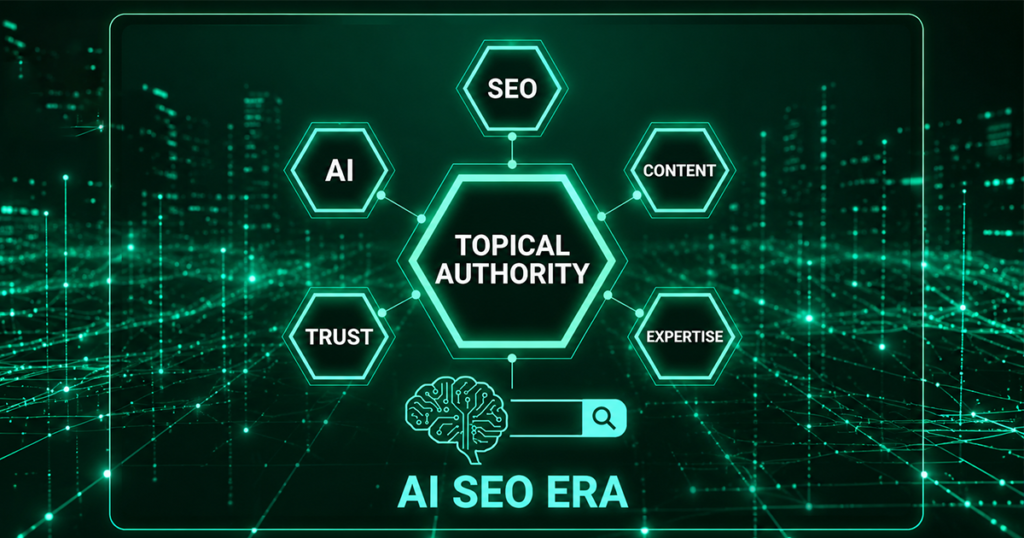
Topical authority is one of the most powerful drivers of organic visibility in modern SEO, especially when competing in saturated markets where every click matters. It determines how well your website is recognized as a trusted source across an entire subject area, not just a single keyword.
For business owners trying to grow predictable leads, understanding topical authority is no longer optional; it’s the difference between ranking on page one or getting buried. If you’re looking for expert support from a trusted seo agency Houston, this is exactly where strategy meets execution at scale.
What Is Topical Authority in SEO?
Topical authority refers to how deeply and comprehensively a website covers a specific subject area in a way search engines can easily understand and trust. Instead of ranking pages individually, Google evaluates whether your entire site demonstrates expertise across connected subtopics.
A site with strong topical authority doesn’t just answer one question; it becomes the go-to resource for an entire niche. That’s why smaller websites with focused content often outrank larger domains that lack structured depth. Google’s Search Quality Rater Guidelines emphasize E-E-A-T (Experience, Expertise, Authoritativeness, Trustworthiness) as a key framework for evaluating content quality, showing how heavily trust signals influence rankings.
Why Topical Authority Matters
Topical authority directly impacts how often your site appears in search results across multiple keywords. Instead of ranking for one page, you start ranking for entire clusters of search intent.
Research from Backlinko shows that the #1 result in Google earns an average CTR of around 27%, while lower positions receive significantly less traffic. This gap becomes even more impactful when authority allows you to dominate multiple top positions.
Key benefits include:
- Higher visibility across hundreds of related keywords
- Stronger trust signals for users and search engines
- More stable rankings during algorithm updates
- Increased organic traffic without scaling backlinks aggressively
How Search Engines Evaluate Topical Authority
Search engines no longer rely only on keywords; they evaluate semantic relationships between content pieces. Google analyzes how well your pages connect, support each other, and cover a topic comprehensively.
A major ranking shift came with advancements in natural language processing, allowing Google to better understand context and intent rather than just matching phrases.
According to Google Search Central, modern ranking systems prioritize helpful, people-first content that demonstrates depth and satisfies user intent across the entire search journey.
How Topical Authority Works
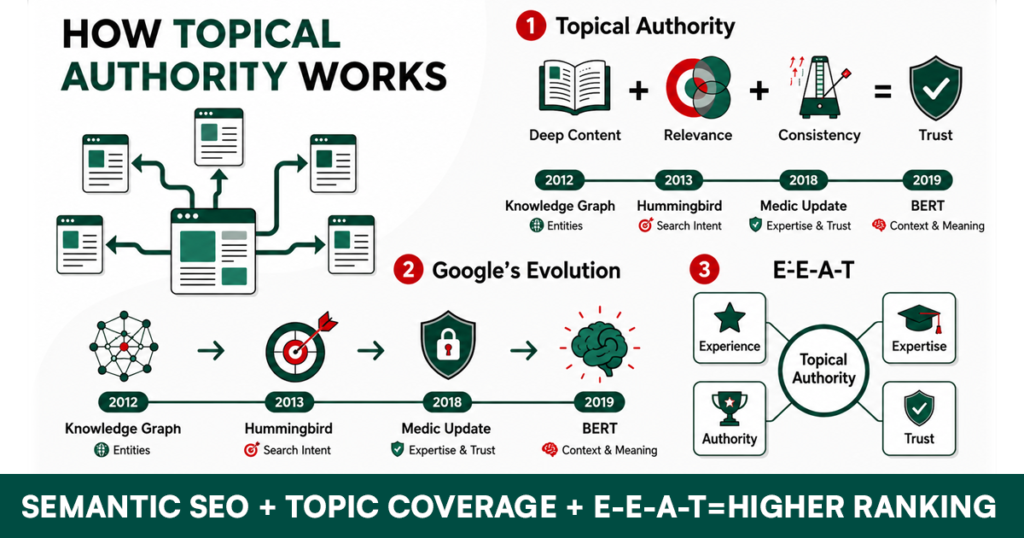
Topical authority works when search engines recognize your website as a trusted source for a specific subject based on content depth, relevance, and consistency. Instead of ranking pages individually, Google evaluates how well your site covers a topic and satisfies user intent across related searches.
Google’s move toward semantic search made topical authority more important. Key updates shaped how search engines understand content:
- 2012 – Knowledge Graph: Helped Google understand entities and topic relationships.
- 2013 – Hummingbird: Shifted rankings beyond keywords to search intent and relevance.
- 2018 – Medic Update: Increased the importance of expertise and trust signals.
- 2019 – BERT: Improved Google’s understanding of language context and meaning.
E-E-A-T also influences topical authority by helping Google assess content quality through Experience, Expertise, Authoritativeness, and Trustworthiness. Combined with semantic SEO and strong topic coverage, these signals help search engines identify your website as a credible source in your niche.
Read more: How to Recover from A Google Algorithm Update Penalty
What Are Topic Clusters
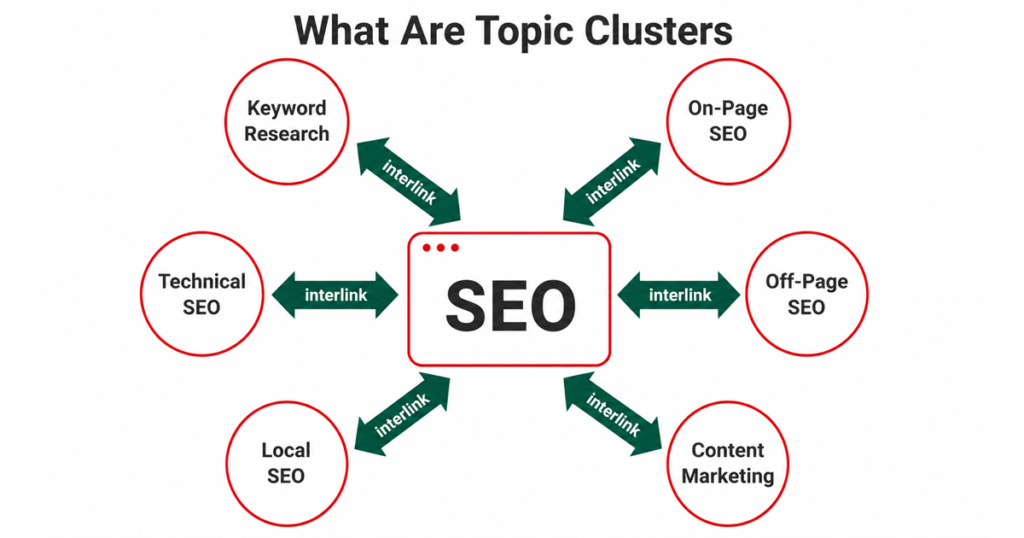
Topic clusters are a content structure model in which a central “pillar page” links to multiple supporting articles that cover related subtopics. This structure helps search engines understand your site hierarchy.
Instead of publishing random blogs, topic clusters create a mapped ecosystem of content. This improves crawlability, internal linking strength, and overall relevance signals.
A strong cluster typically includes:
- One pillar page targeting the main topic
- Supporting blogs targeting long-tail queries
- Strategic internal links connecting all content
How to Build Topical Authority
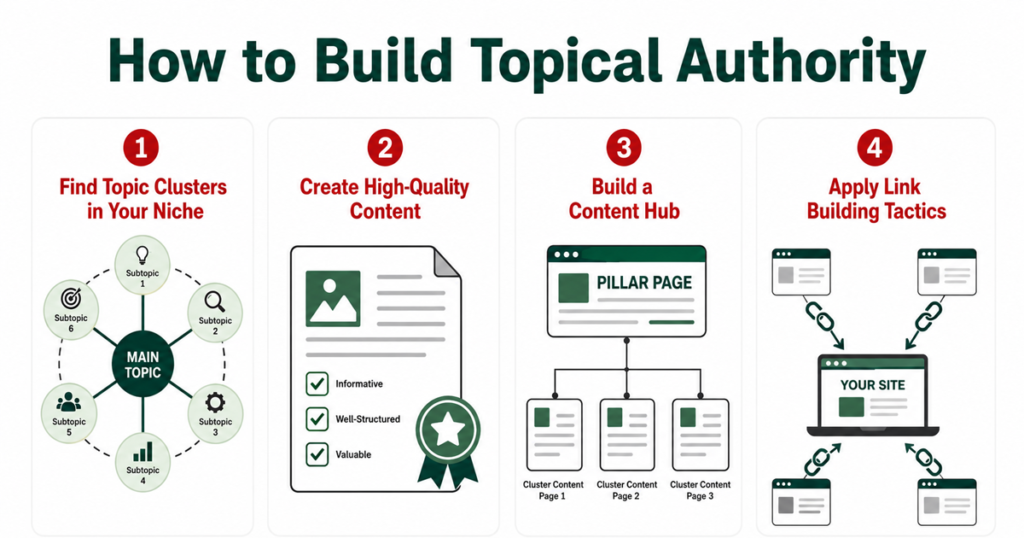
Building topical authority takes more than publishing blog posts randomly. You need a structured content strategy that helps search engines see your website as a trusted source within your niche. The goal is to create interconnected, high-value content that answers user questions at every stage of the journey.
Step 1: Find Topic Clusters in Your Niche
The first step is to identify the core topics your audience cares about and break them into smaller, connected subtopics. Instead of targeting one keyword at a time, think in terms of topic ecosystems.
For example, if you run a digital marketing agency, “SEO” could be your broad topic. Supporting cluster topics may include technical SEO, local SEO, keyword research, on-page optimization, content strategy, and link building.
To build strong topic clusters, focus on different types of search intent:
- Informational searches: “what is topical authority,” “how SEO works.”
- Commercial intent: “best SEO agency,” “top SEO tools.”
- Problem-solving searches: “why my website traffic dropped,” “how to improve rankings.”
This approach ensures your website covers a topic comprehensively rather than competing for isolated keywords.
Step 2: Create High-Quality Content
Once your topic clusters are mapped, the next step is creating content that genuinely helps users. Google rewards pages that answer questions clearly, provide useful information, and keep visitors engaged.
High-quality content should go beyond surface-level explanations. Instead of summarizing what competitors already say, add practical insights, examples, case studies, or unique perspectives that make your content more valuable.
To improve content quality:
- Use clear headings and short paragraphs for readability
- Answer the primary search intent immediately
- Add examples, visuals, or expert insights where helpful
- Keep information accurate and updated regularly
Read more: Content Marketing Strategy: How to Plan, Create & Grow
Step 3: Build a Content Hub
Topical authority grows faster when your content is connected logically. This is where content hubs and pillar pages come in.
A pillar page covers a broad topic in detail, while supporting articles dive deeper into related subtopics. These pages are linked together strategically, helping users navigate your site and helping Google understand your expertise.
For example, a pillar page about “SEO Strategy” may link to supporting blogs about:
- Keyword research
- Internal linking
- Technical SEO
- Content optimization
- Link building tactics
Each supporting article should target a specific long-tail keyword, link back to the pillar page, and connect with related cluster content. This creates a stronger topical relationship across your website.
Step 4: Apply Link Building Tactics
Content alone is powerful, but backlinks help validate your authority. When credible websites link to your content, search engines view those links as trust signals that reinforce your expertise.
The key is earning relevant, high-quality backlinks rather than chasing volume. A few links from respected niche websites often outperform dozens of low-quality mentions.
Effective link-building strategies include:
- Guest posting: Publish valuable insights on niche-relevant websites
- Digital PR: Earn mentions through expert commentary or original research
- Linkable assets: Create original studies, statistics, or helpful resources that people naturally reference
- Unlinked brand mentions: Turn existing mentions of your brand into backlinks
Over time, combining strong content, strategic internal linking, and relevant backlinks creates a compounding effect that improves rankings across entire keyword clusters. If building and scaling this system feels overwhelming, partnering with a trusted digital marketing agency Houston can help you implement a strategy that drives measurable growth faster.
Read more: How to Find Backlinks
How to Use Internal Linking for Topic Authority
Internal linking is one of the most effective ways to build topical authority because it helps search engines understand how your content connects. Instead of treating pages as standalone pieces, Google evaluates how well related content supports a topic across your site.
A strong internal linking strategy helps:
- Connect related pages: Strengthens semantic relationships between topics.
- Boost pillar page authority: Supporting content reinforces core pages.
- Improve crawling and indexing: Makes it easier for search engines to discover content.
For best results, link related articles naturally using descriptive anchor text. Every supporting page should connect back to its pillar page and other relevant content, creating a strong topic cluster that improves rankings over time.
How to Measure Topical Authority
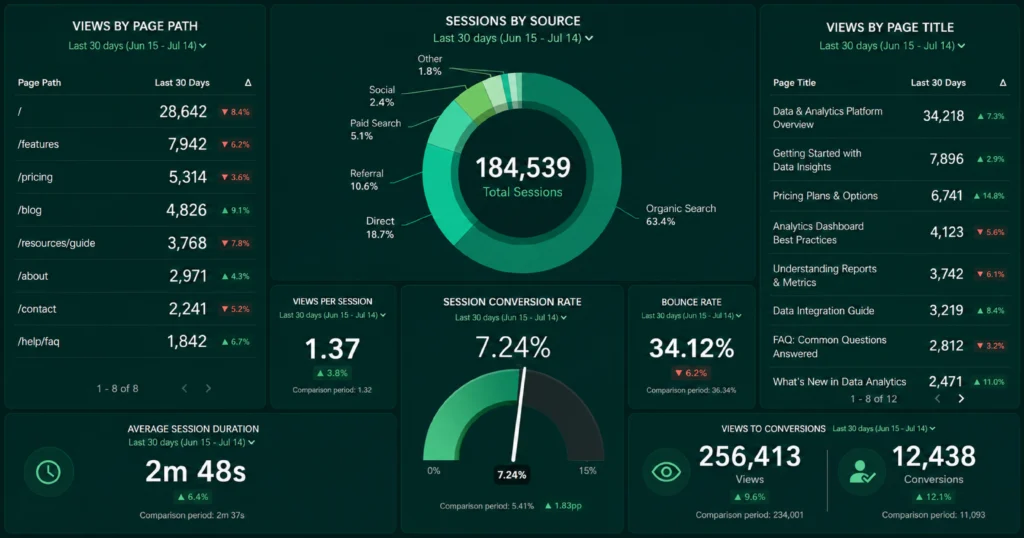
Topical authority isn’t measured by a single metric—it’s evaluated through multiple SEO signals over time. The goal is to track whether your website is gaining stronger visibility and trust within a specific subject area.
Key signals include:
- Growth in ranking keywords: More rankings across related topic clusters signal stronger authority.
- Organic traffic growth: Increased traffic from relevant search queries shows better topic relevance.
- SERP visibility: Higher appearances in featured snippets, People Also Ask, and other SERP features indicate growing authority.
- Internal link strength: A well-connected content structure improves topic relationships and crawlability.
- Backlink quality and relevance: Links from niche-relevant, authoritative websites reinforce trust signals.
- Topical coverage: Evaluate whether your site covers a subject comprehensively or still has content gaps.
- User engagement metrics: Longer time on page, lower bounce rates, and higher engagement often signal helpful content.
Build Stronger Topical Authority with Maddex
Topical authority is not a quick win; it’s a long-term SEO system built on structure, depth, and consistency. When executed correctly, it transforms your website into a trusted source across your entire niche.
The key takeaway is simple: Google rewards websites that fully answer user intent across multiple connected topics, not just isolated pages. That’s where real visibility and traffic growth begin.
If you’re ready to scale faster and avoid costly trial-and-error, Maddex, a Houston-based growth partner, can help you build a strategic content and SEO system that drives measurable results. And if your goal is sustainable rankings and stronger lead generation, this is where building real topical authority becomes your competitive advantage.