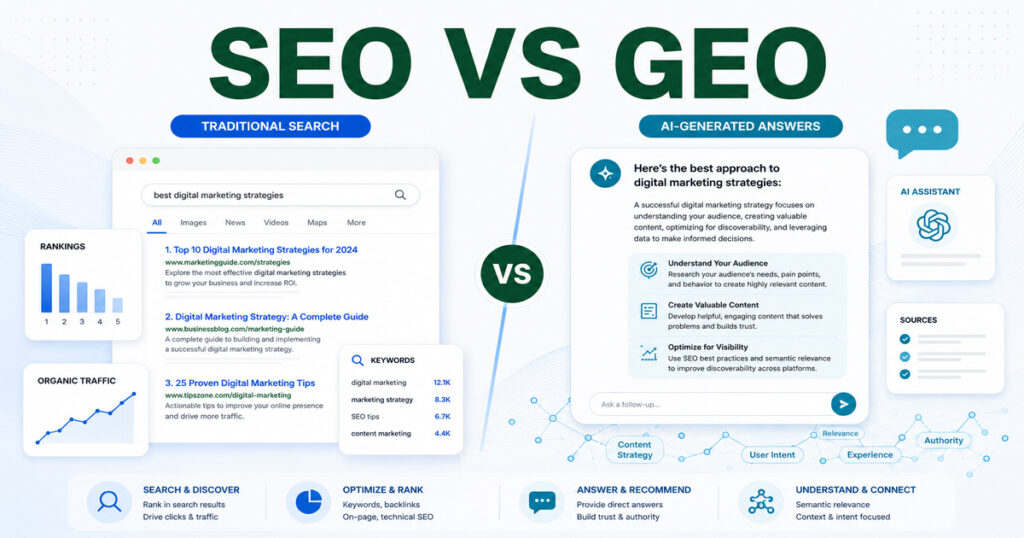
Search has evolved significantly over the last few years. Traditional search engines once relied primarily on keywords and links to deliver results, but today users increasingly receive AI-generated answers instead of lists of blue links. Platforms such as Google AI Overviews, ChatGPT, Gemini, Perplexity, and Bing Copilot are changing how people discover information online.
For business owners trying to grow predictable leads, understanding topical authority is no longer optional; it’s the difference between ranking on page one or getting buried. If you’re looking for expert support from a trusted seo agency Houston, this is exactly where strategy meets execution at scale.
What Is SEO and GEO?
SEO (Search Engine Optimization) is the process of improving a website’s visibility in search engine results pages. It focuses on helping Google understand, rank, and display your content for relevant searches.
GEO (Generative Engine Optimization) is the process of optimizing content for AI-powered search systems that generate direct answers instead of showing links. It focuses on being cited or mentioned in AI responses.
Together, SEO builds rankings, while GEO builds AI visibility.
SEO vs. GEO: The Main Differences
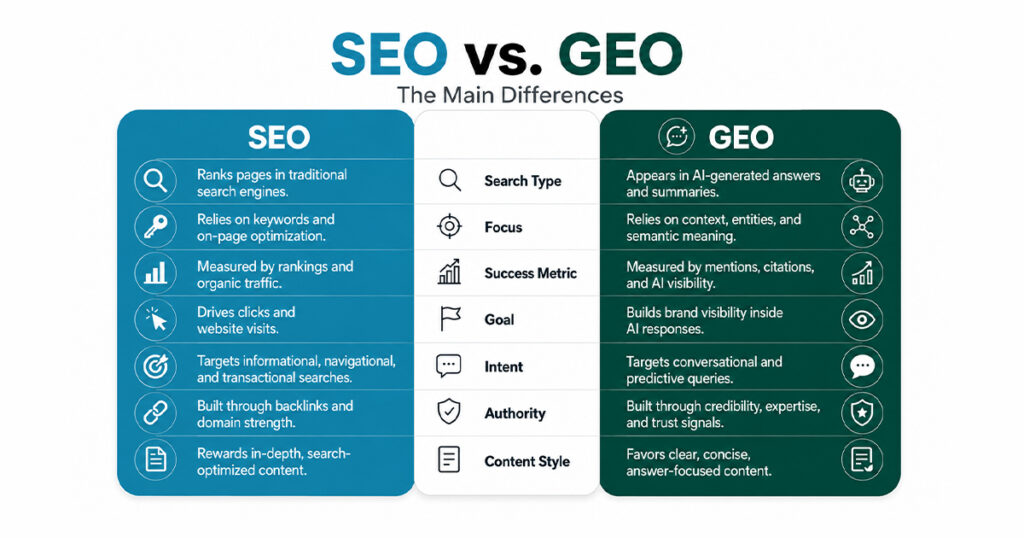
While SEO and GEO both aim to improve online visibility, they work in different ways. SEO focuses on helping web pages rank higher in traditional search engine results, while GEO focuses on increasing visibility within AI-generated answers. Understanding these differences helps businesses, including those working with a digital marketing agency Houston, create content that performs well across both search engines and AI platforms.
Traditional Search vs AI Search
SEO is designed to improve rankings in search engine results pages (SERPs), where users click on links to find information. GEO focuses on helping content become part of AI-generated responses that provide direct answers without requiring users to visit multiple websites.
Keywords vs Semantic Understanding
SEO relies heavily on keyword research and optimization to match user searches. GEO places greater importance on semantic understanding, context, entities, and the relationships between topics so AI systems can accurately interpret and reference content.
Rankings vs Mentions
Success in SEO is typically measured by keyword rankings and search engine positions. In GEO, success is measured through citations, mentions, and how often AI platforms include your brand or content within generated answers.
Traffic vs Visibility
The primary goal of SEO is to drive organic traffic to a website through search engine clicks. GEO focuses more on increasing brand visibility and awareness, even when users receive answers directly from AI platforms without visiting a website.
Search Intent Differences
SEO targets traditional search intent categories such as informational, navigational, and transactional queries. GEO is optimized for conversational and predictive intent, where users ask detailed questions and expect complete answers from AI assistants.
Link Authority vs Entity Authority
Backlinks remain one of the strongest ranking factors in SEO because they help establish website authority. GEO places more emphasis on entity recognition, brand credibility, expertise, and trust signals that help AI systems identify reliable sources.
Long-Form Content vs Answer-Focused Content
SEO often rewards comprehensive content that covers a topic in depth and satisfies search intent. GEO favors content that provides clear, concise, and easily extractable answers while still supporting them with detailed and trustworthy information.
How Search Behaviour Is Changing
Search behavior is rapidly evolving as users increasingly rely on AI-powered platforms for information. Instead of browsing multiple websites, people now expect quick, conversational answers delivered directly through search engines and AI assistants.
- The Rise of Conversational Queries: Users are asking complete questions in natural language rather than searching with short keyword phrases.
- AI Overviews and Instant Answers: Search engines now provide direct answers within search results, reducing the need to click through to websites.
- Voice Search and AI Assistants: Voice search, chatbots, and AI assistants encourage more natural and conversational interactions with technology.
- Impact on Publishers and Businesses: As zero-click searches increase, businesses must optimize not only for rankings but also for visibility within AI-generated responses.
SEO Content Strategy
A strong SEO content strategy helps businesses improve visibility in search engines by combining keyword targeting, technical optimization, and authority building. The goal is to create structured, high-quality content that matches user intent and performs well in search rankings.
Keyword Research
Identify:
- Primary keywords
- Secondary keywords
- User search intent
Optimizing Content Structure
Use:
- Clear heading hierarchy
- Internal linking
- Optimized metadata
Technical SEO Essentials
Focus on:
- Core Web Vitals
- Crawlability
- Structured data
- Mobile responsiveness
Building Authority
Authority can be strengthened through:
- High-quality backlinks
- Digital PR campaigns
- Topic clusters and content hubs
GEO Content Strategy
GEO (Generative Engine Optimization) focuses on optimizing content so it can be easily understood, extracted, and referenced by AI systems. It emphasizes clarity, structure, and semantic meaning rather than just keyword placement.
Entity-Based Optimization
Build strong topical relevance by connecting related topics and clearly defining your subject expertise. This helps AI systems understand your content context and improves the chances of being referenced in AI-generated answers.
Writing for AI Extraction
Content should provide direct answers in a simple and structured format. Clear explanations and easy readability make it easier for AI tools to extract accurate information.
Creating Citation-Friendly Content
AI systems prefer content that includes credible and verifiable information. Adding statistics, expert insights, and research-backed data increases the likelihood of being cited.
E-E-A-T in GEO
E-E-A-T remains a key factor in GEO performance:
- Experience
- Expertise
- Authoritativeness
- Trustworthiness
Strong E-E-A-T signals help build credibility across both search engines and AI platforms.
AI-Friendly Formatting
Content should be structured in a way that is easy to scan and extract. Useful formats include FAQs, definitions, comparison sections, and summaries that improve readability and AI comprehension.
Multi-Platform Content Visibility
GEO is not limited to websites. Content should also be optimized for visibility across AI search tools, knowledge panels, industry platforms, and trusted publications to maximize reach.
Why SEO and GEO Should Work Together
SEO and GEO are not competing strategies. They work best when used together to maximize visibility across traditional search engines and AI-powered platforms. Combining both approaches helps businesses reach users wherever they search for information.
- SEO Still Matters: Organic search remains one of the most valuable sources of website traffic, leads, and long-term business growth.
- GEO Expands Visibility: GEO helps your content appear in AI-generated answers, increasing brand exposure across modern search experiences.
- Hybrid Search Optimization: A combined SEO and GEO strategy improves both search rankings and AI discoverability for broader online visibility.
- Future-Proof Content Strategy: Businesses that optimize for both traditional and AI-driven search are better positioned for future changes in how users find information online.
Best Practices for SEO and GEO Optimization
To maximize visibility across both traditional search engines and AI-powered platforms, businesses should create content that is optimized for rankings, user experience, and AI discoverability. A balanced SEO and GEO strategy improves long-term search performance while increasing the chances of being referenced by AI systems.
- Use Semantic Content Structures: Organize content with clear headings, related topics, and logical content flow to improve understanding for both search engines and AI models.
- Focus on User Intent: Create content that directly answers user questions and satisfies informational, transactional, or conversational search intent.
- Create Helpful Original Content: Publish unique, valuable content that demonstrates expertise and provides real solutions rather than repeating existing information.
- Build Topical Authority: Cover related subtopics in depth to establish your website as a trusted source within your niche.
- Add Structured Data Markup: Use schema markup to help search engines and AI platforms better understand your content and entities.
- Optimize for AI Readability: Write clear, concise answers with easy-to-scan formatting that AI systems can extract and reference.
- Improve Brand Trust Signals: Strengthen credibility through expert content, reviews, citations, author profiles, and authoritative mentions.
- Update Content Regularly: Refresh existing content with new information, statistics, and insights to maintain accuracy and relevance.
Common Mistakes to Avoid
Many businesses unintentionally reduce their SEO and GEO performance by following outdated or low-quality content practices. Avoiding these mistakes is essential for improving visibility in both traditional search engines and AI-powered platforms.
- Keyword Stuffing: Overusing keywords makes content unnatural and can harm both rankings and user experience.
- Thin AI-Generated Content: Low-value or generic AI content lacks depth and is unlikely to rank or be referenced by AI systems.
- Ignoring Search Intent: Content that does not match what users are actually searching for fails to engage or convert.
- Weak Content Structure: Poor formatting and unclear headings make it difficult for search engines and AI tools to understand your content.
- No Entity Optimization: Not clearly defining brands, topics, and entities reduces the chances of being recognized in AI-generated responses.
- Overlooking Technical SEO: Issues like slow speed, crawl errors, and poor indexing can prevent your content from appearing in search results.
- Publishing Generic Information: Non-unique content adds little value and struggles to compete in both SEO rankings and AI visibility.
Future of SEO and GEO
The future of search is rapidly moving toward AI-driven systems that deliver faster, more personalized, and more conversational experiences. As search engines evolve, both SEO and GEO will play a critical role in how content is discovered and consumed online.
- Growth of AI-Powered Search: Search platforms are increasingly relying on AI to generate direct answers instead of just listing web pages.
- Personalized Search Experiences: Results are becoming more tailored based on user behavior, preferences, and search history.
- Reduced Traditional Click Patterns: More users are getting answers directly on search pages, leading to fewer website clicks.
- Greater Importance of Trusted Brands: Authority, credibility, and brand trust are becoming key factors in visibility across both search and AI platforms.
- Expansion of Semantic Web Search: Search systems are focusing more on meaning, context, and relationships between topics rather than exact keywords.
Businesses that adapt early to both SEO and GEO will gain a strong competitive advantage as search continues to evolve toward AI-first experiences.
Want Better Rankings and AI Visibility?
If you want your website to perform well in both search engines and AI-powered platforms, you need a balanced SEO and GEO strategy. Without it, your content may lose visibility in both traditional rankings and AI-generated answers as search continues to evolve.
At Maddex, we specialize in building data-driven SEO and GEO strategies that improve rankings, strengthen technical performance, and increase visibility across both Google and AI search platforms. Our team focuses on fixing SEO issues, optimizing content structure, and aligning your website with modern search behavior to drive consistent traffic, leads, and long-term growth.