If you want fast website traffic, qualified leads, and measurable online growth, understanding what PPC marketing is essential.
According to Google Economic Impact reports, businesses make an average of $2 in revenue for every $1 spent on Google Ads, making PPC one of the most effective digital advertising strategies for businesses looking for immediate results.
Unlike SEO, which can take months to build rankings, paid search ads can start driving traffic and conversions almost instantly. If you want your business to grow with PPC, then partner with PPC agency Houston to improve ad performance, reduce wasted spend, and maximize return on investment.
What Is Pay-Per-Click?
PPC marketing, also known as pay-per-click advertising, is an online advertising strategy where advertisers pay a fee each time a user clicks their ad.
Instead of earning traffic organically through SEO alone, businesses buy targeted visits through paid campaigns.
The most common PPC platform is Google Ads, where advertisers bid on keywords related to their products or services. When users search for those keywords, Google displays relevant ads at the top of search engine results pages.
SEO vs PPC
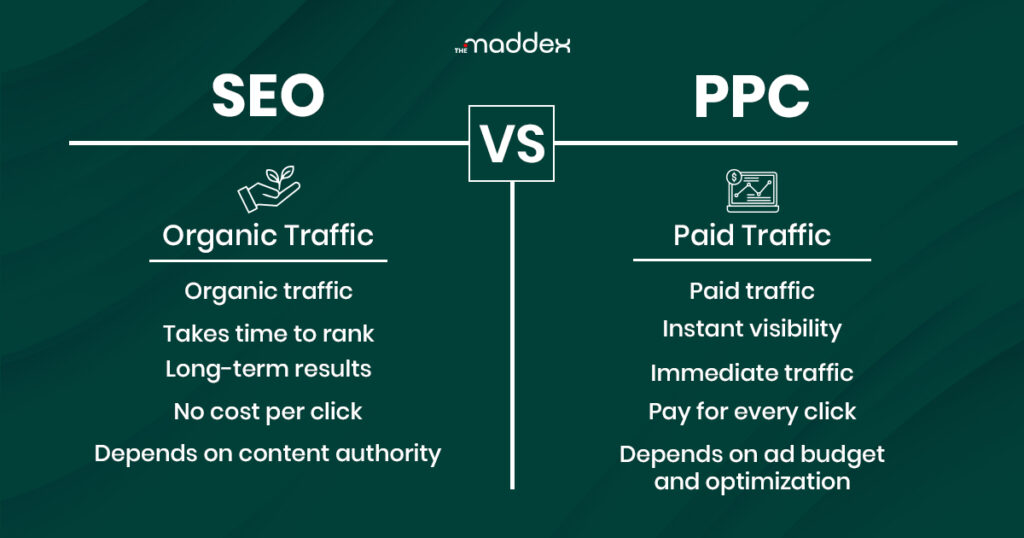
SEO and PPC both help businesses increase online visibility, but they work in fundamentally different ways and serve different marketing timelines.
- Search Engine Optimization (SEO) focuses on earning free, organic traffic by improving your website’s content, technical structure, and authority so it ranks naturally in search engine results. It is a long-term strategy that builds sustainable visibility over time.
- Pay-Per-Click (PPC), on the other hand, is a paid advertising model where businesses pay for each click they receive. It delivers immediate visibility at the top of search results, making it ideal for fast traffic, promotions, and lead generation.
Key PPC Terms
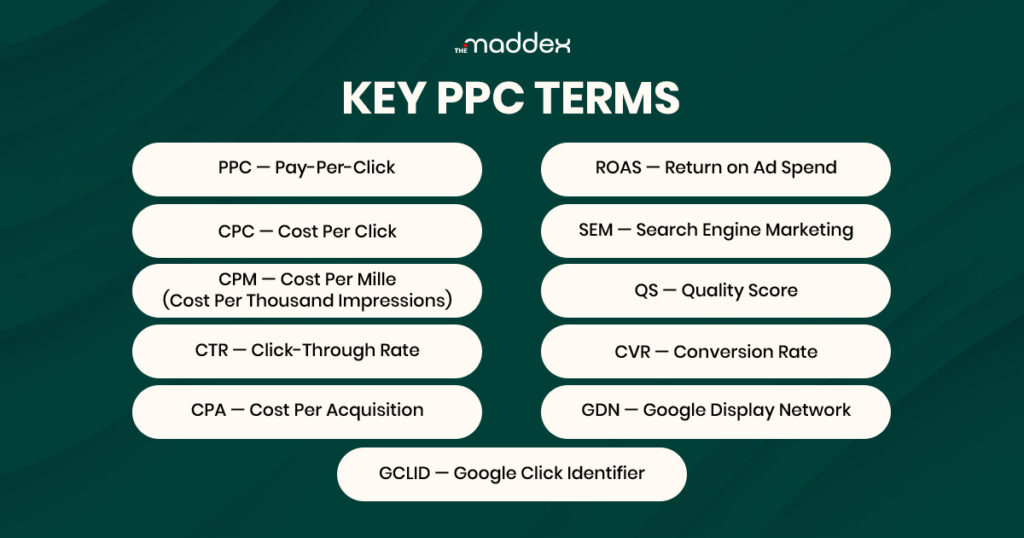
Knowing PPC terminology is essential for running successful pay-per-click advertising campaigns and optimizing performance in platforms like Google Ads, Microsoft Ads, and Meta Ads. Here are the key PPC terms.
How Does PPC Advertising Work?
PPC advertising works through an auction-based system. Advertisers bid on keywords they want to target, and platforms like Google determine which ads appear based on bid amount, ad quality, and relevance.
When users search for a keyword, the platform instantly runs an auction to decide which ads appear first.
Why PPC Is an Important Marketing Tool
PPC has become one of the most powerful digital marketing channels because it allows businesses to target users with high purchase intent. Below are some of the benefits of PPC advertising.
1. Instant Website Traffic
Unlike SEO, which takes time to build rankings, PPC campaigns can start driving traffic the moment they go live.
As soon as your ads are approved, they appear in front of users actively searching for your products or services. This makes PPC especially powerful for new websites, product launches, or time-sensitive promotions where immediate visibility is critical.
2. Fast Lead Generation
PPC is highly effective for generating leads quickly because it targets users who already have intent to buy or take action.
Whether it’s filling out a contact form, booking a consultation, or making a purchase, paid ads bring in high-quality traffic that is more likely to convert compared to general organic visitors.
3. Highly Targeted Audience Reach
One of the biggest strengths of PPC is precision targeting. Advertisers can control exactly who sees their ads based on multiple factors, such as:
- Keywords users search
- Geographic location
- Device type (mobile, desktop, tablet)
- Interests and online behavior
- Demographics like age and income level
- Search intent and previous interactions
This ensures your budget is spent only on the most relevant audience, reducing wasted clicks and improving overall campaign performance.
4. Budget Control
PPC gives complete control over advertising spend. You can set daily, weekly, or monthly budgets based on your business goals and scale up or down at any time.
This flexibility makes it suitable for both small businesses with limited budgets and large companies running high-scale campaigns. Additionally, you only pay when someone clicks your ad, which makes spending more predictable and manageable.
5. Measurable ROI
Every action in PPC advertising is trackable, from impressions and clicks to conversions and revenue. This makes it easy to calculate return on investment (ROI) and understand exactly how your campaigns are performing.
6. Brand Visibility
Even when users don’t click your ads, PPC helps increase brand exposure by placing your business at the top of search engine results pages. This repeated visibility builds trust and brand recognition over time, especially for competitive industries where organic rankings are difficult to achieve.
Many businesses also partner with a professional digital marketing agency Houston companies rely on to manage PPC campaigns more efficiently and maximize return through data-driven optimization strategies.
Types of PPC Campaigns
PPC advertising is not limited to just one format. Different campaign types are designed to match different marketing goals, such as driving sales, increasing brand awareness, or retargeting previous visitors.
1. Search Ads
Search ads are text-based advertisements that appear at the top of search engine results when users actively search for specific keywords. These are one of the most effective PPC formats because they target users with high purchase intent.
Best for:
- Lead generation
- Service-based businesses
- High-intent searches
2. Display Ads
Display ads are visual banner ads that appear across websites, apps, and partner networks within ad platforms like Google Display Network. These ads are more visually engaging and are often used to build awareness rather than capture immediate conversions.
Best for:
- Brand awareness
- Retargeting campaigns
3. Shopping Ads
Shopping ads are product-focused ads that show images, prices, reviews, and store information directly in search results. These are widely used by e-commerce businesses to promote individual products.
Best for:
- E-commerce businesses
- Online retailers
4. Video Ads
Video ads are short promotional videos that appear on platforms like YouTube before, during, or after video content. They are highly engaging and allow brands to communicate messages more effectively through visuals and storytelling.
Best for:
- Brand storytelling
- Product demonstrations
5. Social Media PPC Ads
Social media PPC ads run on platforms such as Facebook, Instagram, TikTok, and LinkedIn. These ads are highly targeted and allow businesses to reach specific audiences based on interests, behavior, and demographics.
Best for:
- Audience targeting
- Engagement campaigns
- Brand awareness
What’s the Best Paid Media Platform for PPC?
Choosing the right PPC platform depends on your audience, goals, and industry.
1. Google Ads
Google Ads is the largest and most widely used PPC platform, offering access to billions of daily searches. It captures users with strong search intent, making it one of the most effective channels for paid search ads and high-converting traffic.
Best for:
- Local businesses
- Service providers
- E-commerce stores
- Lead generation campaigns
2. Microsoft Ads (Bing Ads)
Microsoft Ads, commonly known as Bing Ads, is a powerful alternative to Google Ads that runs across Bing, Yahoo, and partner networks. It often has lower competition and cheaper cost per click (CPC), making it a cost-efficient option for many businesses.
Best for:
- B2B marketing campaigns
- Professional services
- Older or desktop-heavy audiences
3. Meta Ads
Meta Ads include Facebook and Instagram advertising, offering one of the most advanced audience targeting systems in digital marketing. Instead of relying on search intent, Meta focuses on user interests, behavior, and demographics.
Best for:
- E-commerce marketing
- Visual product promotion
- Retargeting campaigns
- Brand awareness campaigns
4. Amazon PPC
Amazon PPC is a highly conversion-focused advertising platform that allows sellers to promote products directly within Amazon search results and product pages. It is essential for e-commerce brands competing in the marketplace ecosystem.
Best for:
- E-commerce sellers
- Product-based businesses
- Amazon FBA brands
5. TikTok Ads
TikTok Ads are designed for short-form video advertising and have become one of the fastest-growing PPC platforms globally. The platform is driven by entertainment-based content, making ads feel more native and engaging.
Best for:
- Brand awareness campaigns
- Viral marketing strategies
- Gen Z and millennial targeting
- Creative storytelling ads
How to Calculate PPC ROI
Calculating PPC ROI (Return on Investment) is essential for understanding whether your pay-per-click advertising campaigns are actually profitable or just generating traffic without business value.
Step 1: PPC ROI Formula
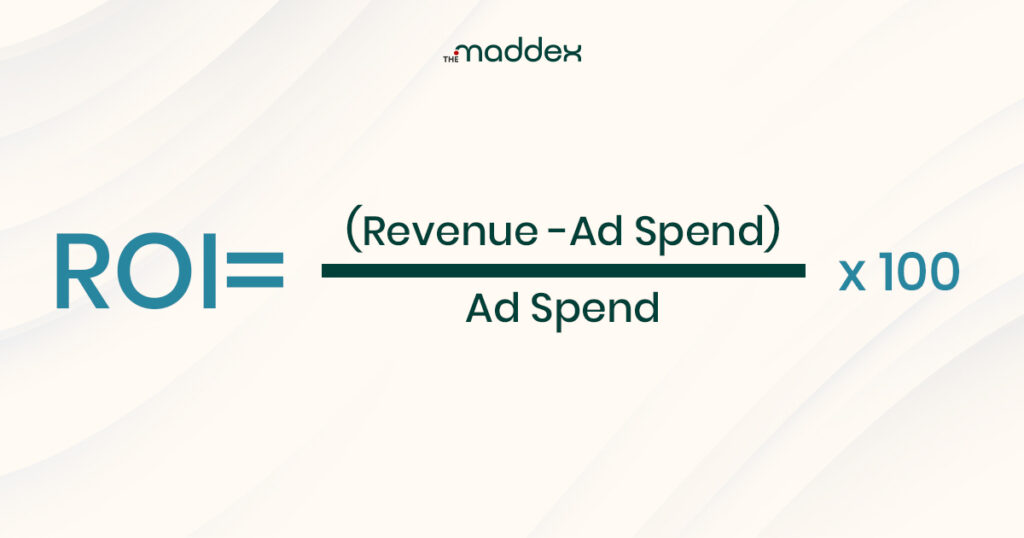
The foundation of PPC ROI calculation is a simple formula:
- ROI = (Revenue – Ad Spend) ÷ Ad Spend × 100
This formula helps you measure profit or loss from your PPC campaigns in percentage form. A positive ROI means your campaign is profitable, while a negative ROI means you are spending more than you are earning.
Step 2: Track Total Revenue
To calculate an accurate ROI, you must first track how much revenue your PPC campaigns are generating.
This includes:
- Sales from paid search ads
- Leads converted into customers
- E-commerce purchases from ad traffic
Without proper conversion tracking (using tools like Google Ads or GA4), you cannot measure true PPC performance or ROI.
Step 3: Calculate PPC Ad Spend
Your total ad spend includes all costs related to running your campaigns, such as:
- Cost per click (CPC) charges
- Daily or monthly ad budgets
- Platform fees (Google Ads, Meta Ads, etc.)
- Cost of running multiple campaigns
This gives you a clear picture of how much investment you are putting into your PPC marketing efforts.
Step 4: Apply the ROI Formula
Once you have both revenue and ad spend, plug them into the ROI formula.
For example:
- If you spend $1,000 on PPC campaigns
- And generate $3,000 in revenue
Your ROI would be:
- (3000 – 1000) ÷ 1000 × 100 = 200% ROI
This means your campaign is earning twice the amount you spent.
Step 5: Understand ROAS
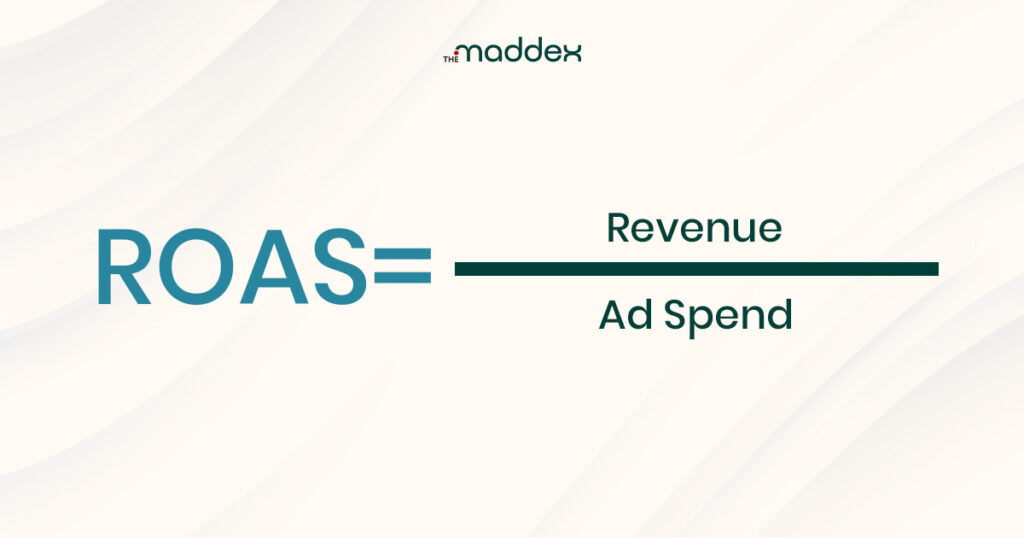
Along with ROI, many advertisers also track ROAS (Return on Ad Spend), which is slightly different but equally important.
- ROAS = Revenue ÷ Ad Spend
For example:
- $3,000 revenue ÷ $1,000 spend = 3.0 ROAS
This means you earn $3 for every $1 spent on PPC advertising.
Step 6: Evaluate Performance
Once ROI is calculated, the next step is improving it over time.
To increase PPC ROI:
- Focus on high-intent keywords
- Improve ad copy relevance
- Optimize landing pages for conversions
- Reduce wasted spend on irrelevant clicks
- Continuously test and refine campaigns
Better optimization leads to lower cost per acquisition and higher profitability.
Is PPC Worth It?
Yes, PPC is worth it when managed strategically. Pay-per-click advertising helps businesses drive instant traffic, generate qualified leads, and reach high-intent customers faster than many other marketing channels. When campaigns are properly optimized, PPC can deliver strong ROI and measurable business growth.
PPC Best Practices in 2026
To run profitable PPC campaigns in 2026, businesses need to focus on optimization strategies that improve targeting, reduce wasted spend, and increase conversions. These best practices help maximize performance across all major pay-per-click advertising platforms.
- Focus on Search Intent Keywords: Targeting the right keywords is the foundation of successful PPC campaigns. Focus on high-intent keywords that indicate users are ready to take action, such as “buy,” “hire,” “quote,” or “near me.”
- Improve Quality Score: Quality Score directly impacts your ad ranking and cost per click in platforms like Google Ads. By improving ad relevance, keyword alignment, and landing page experience, you can achieve higher rankings at lower costs.
- Use Negative Keywords: Negative keywords help you filter out irrelevant traffic and prevent wasted ad spend.
- Test Multiple Ad Variations: A/B testing different ad copies helps identify what resonates best with your audience.
- Optimize for Mobile Users: Since most PPC traffic now comes from mobile devices, mobile optimization is critical for success.
- Use AI Automation Carefully: AI-powered bidding and campaign optimization tools can improve efficiency and save time.
Get Expert PPC Management Services with The Maddex
PPC helps businesses generate fast traffic, increase leads, improve sales, and reach customers with high purchase intent.
When managed properly, pay-per-click advertising delivers measurable growth and scalable results for businesses of all sizes. However, successful campaigns require strategy, optimization, keyword research, and continuous performance tracking.
If you want to maximize your PPC results, partnering with experts can make a significant difference. The Maddex provides professional PPC management solutions designed to help businesses increase conversions, lower ad costs, and grow revenue through data-driven paid search strategies.